

I am currently a teaching assistant for an Introduction to Biological Engineering course. It is the first time I have been directly involved with teaching beyond mentorship or guest lectures since I was a student teacher (eight years ago?!?), and I’m enjoying it just as much now as I did then. Currently my role is quite small, just helping with the labs, and grading assignments but that will change soon. I find the interactions with students to be quite enjoyable and immensely helpful as I consider how to teach my courses in the future.
From novice to “expert”
One aspect that has amused me greatly is recognizing how far I have come in my own learning. At the start of my masters I hadn’t ever touched a programming language. Now I am responsible for grading and aiding in troubleshoot the students code. I remember feeling slightly exasperated and saying “I can’t figure out why this code won’t run” to the instructors only for them to glance at my screen and mention something like a missing comma, or misspelled variable. It’s hard not to give them the full answer when I identify the issue, but essential to makes sure they learn what the mistake looks like and how to fix it. I consider it an act of “passing it forward” from my instructors to my students.
AI in Education
One of the introductory labs assumes that students have never programmed before, which is true for over half the class. Instead of teaching the very basics of programming which would be covered in other classes, one assignment I am grading has them use large language models to write code for analyzing data and creating charts.
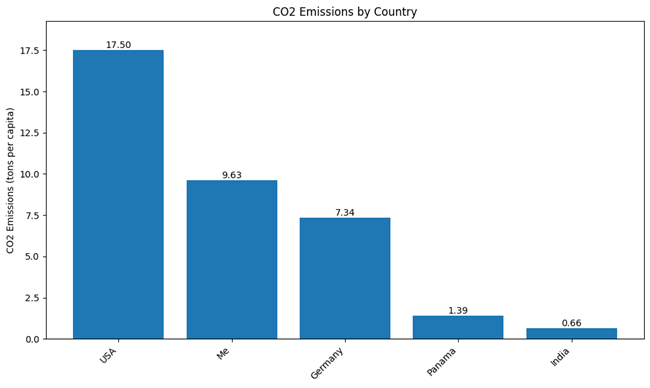
The assignment is rather lenient to accommodate the fact that this is an exercise in unit conversion, not programming skill, but that still leaves much room for growth. I spent a fair amount of time adding comments to the grades to highlight better practices, and to praise extra efforts as it became clear to me which scripts were completely AI generated.
An interesting side effect of this was terrible formatting of charts. Since the students didn’t necessarily have the experience with changing font sizes, adding elements or the countless other options many of them were unaltered versions of what the AI provided. Next time I plan to include formatting in the rubric to encourage a bit more exploration of programming beyond copy/paste in hopes that they learn how to make their own changes without AI.
Trust in Numbers
This specific assignment dealt with calculating their own carbon and water footprints and comparing them to estimates from other sources. The range of answers depended on the individuals’ habits as expected, but a few special cases made me pause for a moment. Occasionally a student would get some outrageous value, recognize this, and move forward with the assignment building upon these values.
These responses are exactly the kind that illustrate the need for critical thinking in education. As such I took extra time to highlight these mistakes and spend time responding to them. After all, if they are going to be engineers it is important to ensure that they can set aside feelings of trust in the math to check their own work and the work others.
Conclusions
This brief experience grading an assignment I didn’t even write has reminded me of what it is like to teach new skills to students and given me a glimpse into how AI can be introduced and/or used in classrooms. The ability to have students interacting with code as an introduction is quite useful. The experienced students can flex their abilities a bit and the novices can see how it is used without taking multiple lectures to provide the framework needed to create something like a chart.
Even though this was an exercise of unit conversions it highlights the need to incorporate thought processes of critical thinking into the material. Doing so requires patience from the instructor to guide the students before, during and after the assignment. A gentle nudge in the right direction combined with a chance to learn and improve can do far more than a single shot attempt or quickly fixing the issue by providing the answer.
Proudly written without large language models.
©Donald Coon 2025 available at https://doi.org/10.5281/zenodo.13870329
This work is licensed under CC BY 4.0
 Donald S. Coon