
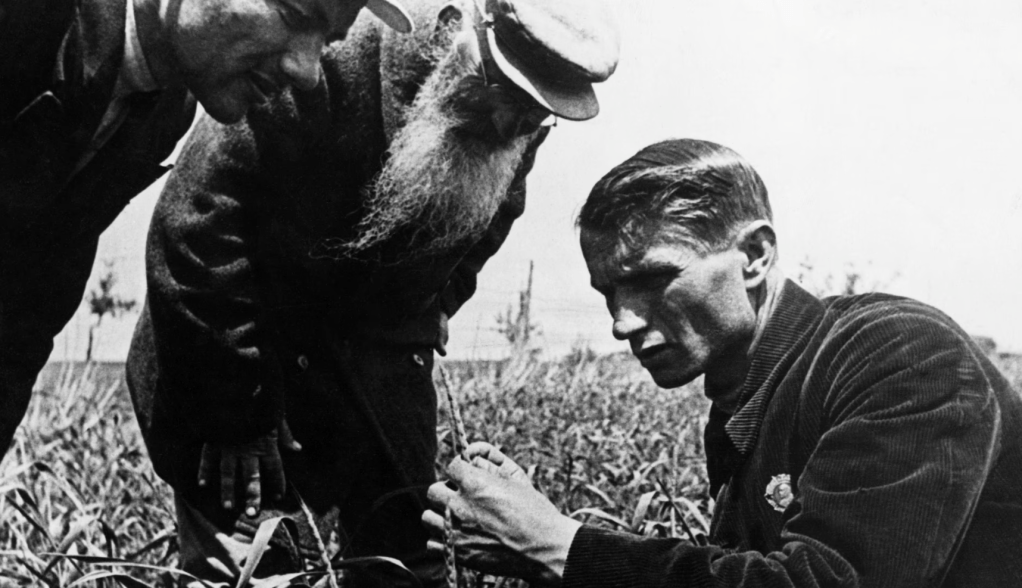
Introduction to Lysenkoism
Trofim Lysenko was born to a family of peasants, but would one day rise to be a highly influential scientific authority in the USSR. He was an agronomist by training and was a supporter of the inheritance of acquired characteristics theory. This was originally a Lamarckian view where an individual’s traits are hereditary. For example, a blacksmith with strong muscles will produce children with enhanced musculature [1]. Lysenko was of the belief that wheat, a critical crop for the USSR could be improved through breeding that exposed seeds to cold temperatures (vernalization) to force the acquisition of cold tolerance needed for much of the USSR [2].
Despite the awards and support he gained from the Communist Party leaders, his efforts with wheat, potato, and cotton ultimately failed to produce the promised 5-10 fold yield increases and accelerated breeding timelines [3]. What did happen was he used his political support and his positions to declare genetics a “bourgeois perversion” followed by an order from the Communist Party of the Soviet Union prohibited genetic research in the USSR.
At this point, thousands of scientists who protested were expelled from Soviet Russia, with the remaining put under the watch of Commissars, to ensure political control and adherence to doctrine. For those who remained but were unable to unconditionally agree with the Party’s decrees—or tried to dispute its decisions in light of scientific fact—consequences ranged from destruction of research, to imprisonment, and even death [2]. In addition, the application of the science Lysenko supported lead to massive crop failures and famine.
Parallels from Lysenko to Today
Lysenko became such an influential figure by aligning his “science” with a political power and subsequently using that position to attack, purge, and defund actual, factual science. It is quite easy to find numerous people making the connection between Lysenko and RFK Jr., the US Secretary of Health and Human Services. If you want more about that, I recommend David Gorski who has written multiple articles on just this subject. While these days the state of genetics and inheritance of traits is widely accepted, the attempts to erode trust in science to further personal, financial, or political gain echo that of Lysenko.
The executive order “Restoring Gold Standard Science” seems innocuous enough by calling for reproducible, transparent, interdisciplinary, peer reviewed, and conflict of interest free science. However, just 5 days later, RFK Jr.—the former lawyer without a scientific background—proclaims that “We’re probably going to stop publishing in the Lancet, New England Journal of Medicine, Jama and those other journals, because they’re all corrupt,” and goes on to outline the plan to create government-run journals. The order also goes into detail on the enforcement of the gold standard by senior appointees by the President.
The impacts of this can already be seen unfolding in the US Department of Veterans Affairs where doctors Pavan Ganapathiraju and Rebecca Traylor wrote a perspective piece published in the New England Journal of Medicine warning of the health risks to veterans as a result of cancelled contracts and massive layoffs. This “potential for negative national exposure” was met with pushback from their Senior Appointee(s) matching a pattern of censorship that aligns with a “war on science.”
Conclusions
The “Gold Standard for Science” was already the gold standard; the last thing it needs is appointees—without a scientific background nonetheless—to declare which science is “good” according to them or the people who appointed them. Despite its rigor and peer review, science is not always perfect; but the flaws are known and being addressed by the community. What is not needed is outside parties to provide censorship and undermine scientific integrity. The patterns of RFK Jr. and this administration follow that that lead to the rise of Lysenko, his perversion of science, and the catastrophic impacts it had.
Cited References
1. Lamarck, J.B.P.A. de M. de Philosophie Zoologique, Ou Exposition Des Considerations Relatives a l’histoire Naturelle Des Animaux, Volume 1; G. Bailliere, 1830;
2. Soyfer, V.N. The Consequences of Political Dictatorship for Russian Science. Nat Rev Genet 2001, 2, 723–729, doi:10.1038/35088598.
3. Soĭfer, V. Lysenko and the Tragedy of Soviet Science.
Proudly written without large language models, even though it has emdashes, which I learned to use from my wife, an editor.
©Donald Coon 2025 available at https://doi.org/10.5281/zenodo.15783948
This work is licensed under CC BY 4.0

 Donald S. Coon