
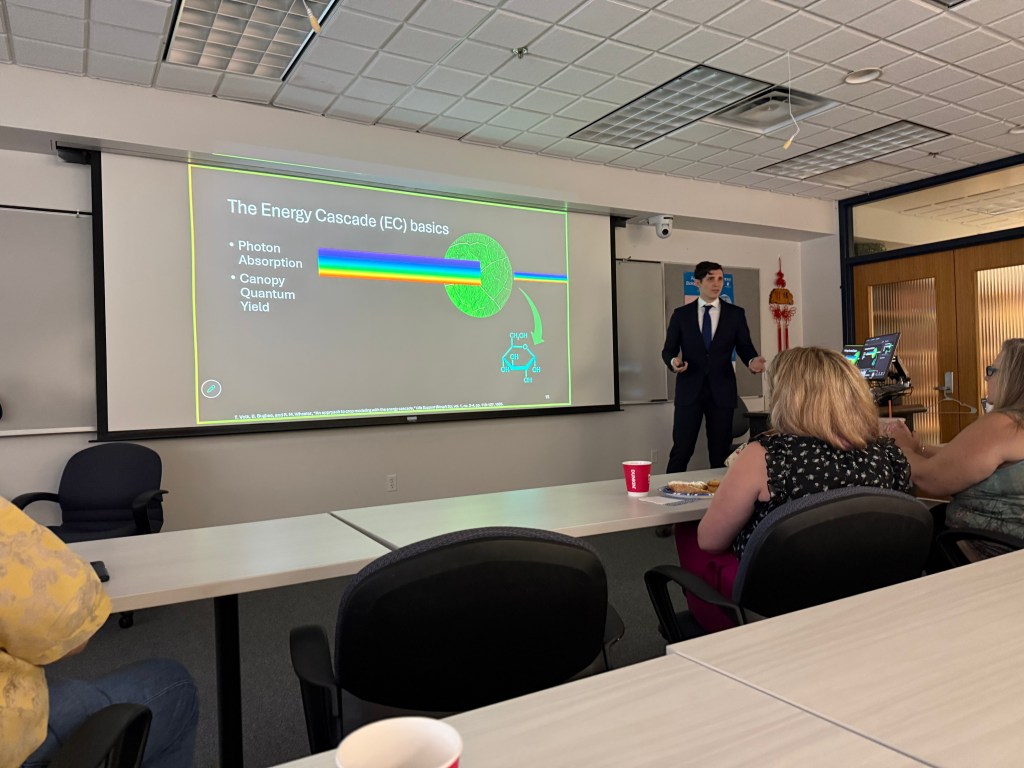
Last week I defended my Ph.D. Dissertation. Now I am Dr. Coon, and unless someone is hiding in a corner of academia studying the ECs without telling anyone, I feel confident saying that I am the world’s foremost expert on the Energy Cascade (EC) crop models. Many folks know the models, and some have used them, however I picked apart four different versions, analyzed them, and created a new one to improve upon their shortcomings. The defense, and my upcoming graduation are the culmination of five years of work. I wanted to take a moment to stop and think about some things I learned and experienced along the way before moving onto what’s next.
A new way to communicate
I spent a lot of time in the past learning how to talk and present. I learned how to effectively lead lessons and give speeches as part of my education degree and in my FFA activities. These experiences taught me how to grab people’s interest and maintain their attention while speaking, but what they didn’t teach me was how to effectively communicate through writing. I often fell into the trap that many graduate students do where I got preoccupied with the methods and results, neglecting the gaps and impact of the work. On top of that, the more I learned, the more I felt everything was important and needed to be said ending up with an over abundance of details. It took a while to adjust to this new communication method, but through the instructions and guidance from my mentors, and lots of practice, my writing has improved vastly.
Stepping into a new community
I knew an important part of science was collaborating with others and engaging with the community, but until I began working on my Ph.D. I didn’t fully appreciate what that meant. Throughout the years I have made connections with people from across my university, the country, and the world. I was welcomed by this large group of researchers and knowing they look forward to hearing about my work drives me forward. I couldn’t possibly list them all, but I am grateful for getting to know each one of them and get excited seeing a new paper from them or the potential to see them again at the next conference. We all celebrate our wins and do our best to help each other out when possible. They even enrich my non-academic life like my pen pal in the Arctic circle, the group chat dedicated to baking I was invited to join, or just general friendship beyond people in my immediate vicinity.
Finally getting it done
The first few years of the program were dedicated to classwork, planning research, and some preliminary analysis. Even as I began the experiments and truly worked on the EC models in the last year it felt like I was just doing things that were ultimately inconsequential. Some days the concept of imposter syndrome made a lot more sense as I doubted myself and my work. It wasn’t until the last month or two as I began compiling results into the dissertation that that feeling seemed silly. I had identified a potential research gap in the ECs, confirmed it with some analysis, developed a plan to collect data needed to correct it and followed through with the plan. The end product being a complete story of a much-needed modification to the ECs. That realization helped me keep going throughout long days needed to get the dissertation complete before the deadline.
Conclusion
It’s hard to condense five years of experiences and learning into one short passage. These kinds of things would never make it into a dissertation, but they were essential to the entire Ph.D. experience that made it a worthwhile endeavor. It was a lot of work but the skills, people, and sense of purpose it provided were extremely valuable to me.
©Donald Coon 2026 available at
This work is licensed under CC BY 4.0

 Donald S. Coon