
Over the years I have written a few different things that dive into different aspects of my research. What is below is a portion of a letter of interest I wrote summarizes everything that gradually accumulated over my Ph.D. and what I plan to do next quite well. Instead of just having the people reviewing my application be the only ones to see it I thought I would share it here too.
Background
My science career began with controlled environment agriculture; its semi-closed nature where nearly every input a plant receives can be manipulated towards a specific outcome made greenhouses and indoor farms ideal to learning plant science. That interest shaped my masters in controlled environment agriculture focusing on plant physiology and led me to manage the interconnected fish and lettuce systems at Traders Hill Farm, a commercial aquaponic greenhouse. At the University of Florida’s Agricultural and Biological Engineering Department, I saw the same principles at a higher level of integration where plant systems could manage water and oxygen while producing food as a core element of Bioregenerative Life Support Systems (BLiSS). That progression from narrowly focused on plants to encompassing larger production systems is what now drives my research plan towards space crop production. I aim to teach plant science and systems modeling through practical and timely lessons derived from BLiSS research.
Previous Work
My Ph.D. research revolved around the Energy Cascade crop models. The original Energy Cascade was developed in the 1990’s to aid in the prediction of biomass accumulation in BLiSS [1]. This modeling approach was adopted and modified three separate times, being used to model a ground-based lunar greenhouse [2] and as the NASA’s recommendation for planning space crop production [3]. These models were adopted with minimal assurances of their accuracy, and my retrospective analysis showed that they were severely over-parametrized, insensitive to temperature, and produced erroneous predictions of biomass and transpiration that would lead to inadequate BLiSS designs and functioning if they were used [4].
To address this, I developed the Advanced Energy Cascade (AEC) as a first step toward fixing these models. The AEC addresses the known temperature insensitivity by using data from a heat stress trial to modulate canopy dimensions, greatly improving the predictions of biomass and transpiration across a wider range of temperatures compared to the previous Energy Cascades. To investigate whole-canopy gas exchange, I secured a NASA Florida Space Grant Consortium Dissertation Improvement Fellowship, which funded work at the University of Guelph’s Controlled Environment Systems Research Facility. I plan to manage and develop the AEC iteratively with other researchers to ensure its continued accuracy and functionality for when true space crop production systems are being designed and constructed.
Future Research
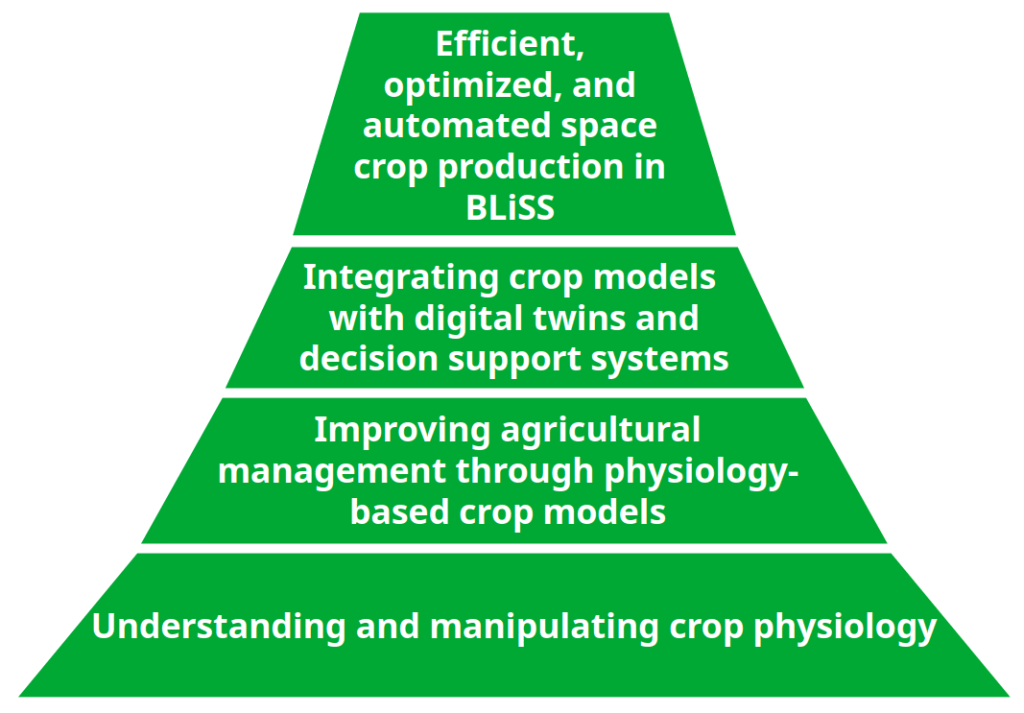
Long-duration crewed missions will need fresh food, water, and air, plus the ability to process waste. Plant production is seen as essential to the success of these crewed missions due to the ability to simultaneously revitalize air and water resources while producing fresh nutritious food. My future research plans to support space crop production efforts through basic plant science, predictive modeling, and, ultimately, systems design and operation as part of a larger BLiSS framework. The foundation of my work will rely on basic plant science such as genetic and physiological responses of crops and their growth systems to reduced gravity, ionizing radiation, and altered atmospheres. Conditions can be partially simulated on the ground, but nothing truly replicates the full spaceflight environment without leaving Earth’s gravity, which is why flight experiments are essential. Data from spaceflight experiments will be needed to create predictive crop models that account for the genetics, unique environment, and management of space crop production. The upper two levels of my plan will require the integration of my research with others to create the tools, such as digital twins of crop production systems, to design and manage efficient, optimized, and automated crop production as part of the BLiSS required for long duration crewed missions.
References
[1] T. Volk, B. Bugbee, and R. M. Wheeler, “An approach to crop modeling with the energy cascade,” Life Support Biosphere Sci. Int. J. Earth Space, vol. 1, no. 3–4, pp. 119–127, 1995.
[2] G. Boscheri et al., “Modified energy cascade model adapted for a multicrop Lunar greenhouse prototype,” Adv. Space Res., vol. 50, no. 7, pp. 941–951, Oct. 2012, doi: 10.1016/j.asr.2012.05.025.
[3] M. K. Ewert, T. T. Chen, and C. D. Powell, “Life Support Baseline Values and Assumptions Document,” Life Support, p. 235.
[4] D. Coon et al., “Performance and sensitivity of the energy cascade models for lettuce production in bioregenerative life support systems,” Silico Plants, May 2026, doi: https://doi.org/10.1093/insilicoplants/diag011.
Proudly written without large language models.
©Donald Coon 2026 available at
This work is licensed under CC BY 4.0


